Why Your Dog Won't Listen Outside (And 4 Reasons Behind It)
Having a dog that won't listen outside is exhausting, and if I'm honest, it's pretty embarrassing too. You leave the house, and within about thirty seconds (if you're lucky) your dog turns into a chaotic mess that looks like it's never been trained a day in its life. Every head turns. You're constantly apologising to a stranger for the third time this week...and somewhere in the back of your mind you're wondering if this is just what your life looks like now.
When I was at the beginning of my journey with my first dog Jasper, going outside was a nightmare. He'd react to every dog or pull me around just so he could say hi to people. For a while I didn't mind, but then it started becoming pretty frustrating as he not only started to tune me out on these walks, but also these walks stopped meeting his needs because he was more obsessed with everything else than the actual walk.
There are many reasons a dog won't listen outside, and most owners only ever get told about one or two of them, so I want to dive into 4 common reasons in this post.
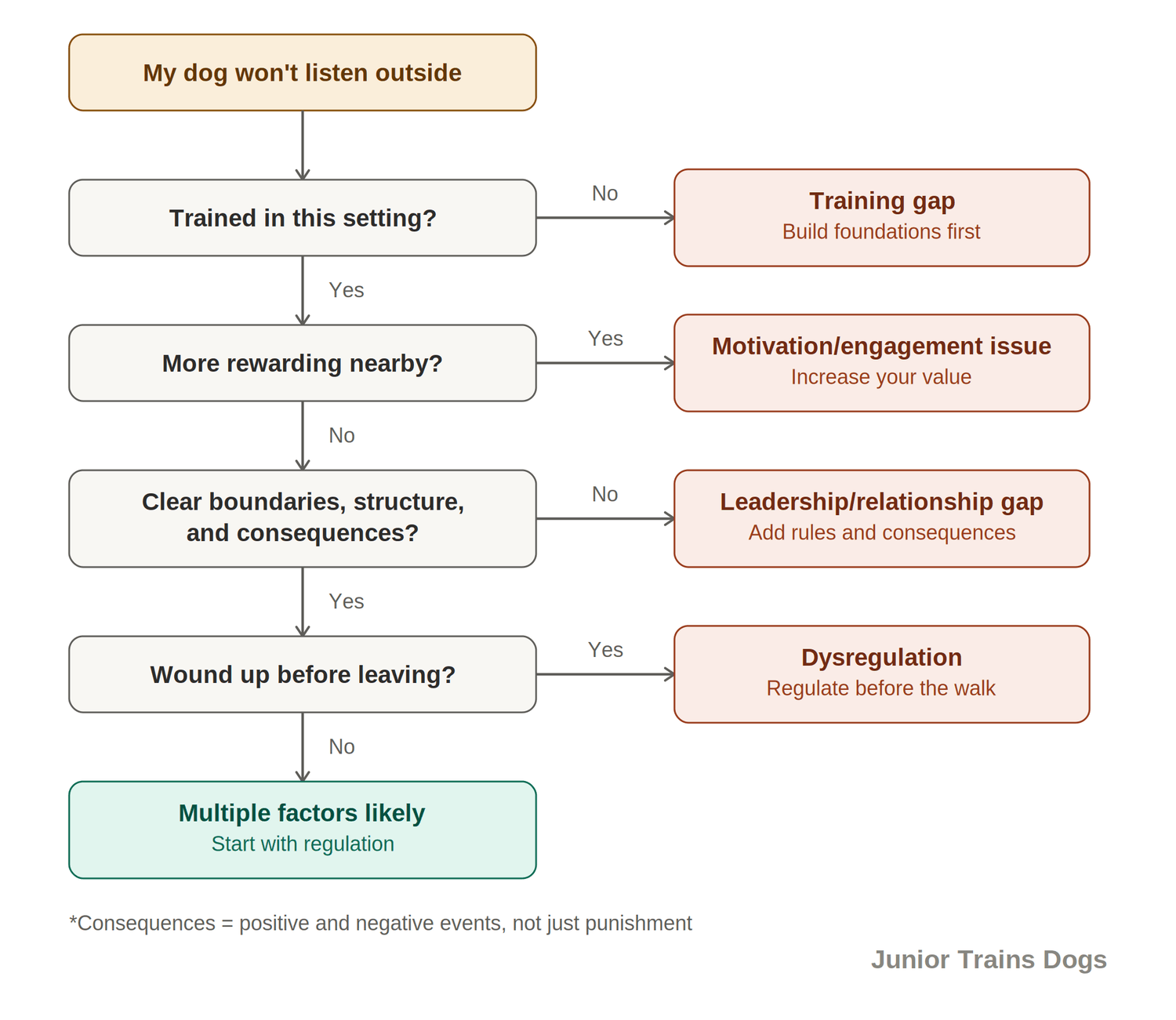
Check out the flow chart below for a quick look at all four, then stick with me through each one, because the last one is the one I actually fix first with real clients, not last.
Reason #1: Your Dog Won't Listen Outside Because of Poor Training
The most obvious reason (and for a lot of owners even if they don't want to admit it) is poor training and foundations.
Poor training and foundations can come from multiple different factors:
Maybe you have a communication issue...
Maybe your dog hasn't actually been taught to do the actual skill you want yet...
Maybe they know "sit" in your kitchen but have never once been asked (or trained) for it next to a busy road...
Maybe you've only practised the skill a handful of times and assumed that was enough...
Maybe you're just expecting behaviour outside that you've only ever built in the comfort of your own home, in situations that are honestly above your dog's current skill level...
For those who do have poor foundations and training, the fix is pretty simple: rebuilding the foundations from the ground up.
When you've got solid foundations, you've trained in the environments that actually matter, and your dog understands what you're asking of them, they're far more likely to actually do it.
Reason #2: Your Dog Won't Listen Outside Because of Competing Motivators
Motivation has a huge influence in whether you dog will listen or not, and right now, for a few of you out on that walk, you're simply not the most interesting thing available to your dog. Maybe it's a squirrel. Maybe it's every person on the street they want to say hello to, jump up on, get all over. Maybe it's the smell another dog left behind twenty minutes ago. Whatever it is, in that moment, it's competing with you for your dog's attention, and something else is winning.
This is what's called a competing motivator, and for something to compete, it has to actually have value to your dog. Which means the fix isn't punishing them for looking at the squirrel. It's making yourself worth choosing over the squirrel in the first place.
Reason #3: Your Dog Won't Listen Outside Because of Leadership and Relationship
This one's less about arousal or motivation and more about whether your dog actually sees you as worth listening to at all.
If you have no structure at home, no rules that get followed through on, no consequences...then your dog has no real reason to check in with you outside the house.
(And just to be clear, I don't just mean punishment, a consequence is just whatever happens after your dog does something, and it can be something good too, praise, a reward, real acknowledgement when they get it right, not only a correction when they get it wrong).
When nothing ever follows what they do, or if you say something and it doesn't get backed up either way, they learn pretty quickly that what you say doesn't actually mean anything, so they stop bothering to listen for it.
At the same time, if there isn't much of a relationship built up either (not enough good shared experience between the two of you) there's nothing actually compelling them to work with you.
Put those two things together and you get a dog that's neither respecting your boundaries nor particularly bonded to you, and honestly, either one on its own is enough to make your dog tune you out the second you're outside.
Reason #4 (The One Most Owners Miss): Regulation
The final reason is the one that's consistently overlooked, but it's also the first thing I actually work on with owners. Not training. Not motivation. This.
Regulation is the systems used to control a process...think of it like a thermostat in your house. Too hot, the air-con kicks in. Too cold, the heating turns on. That's regulation.
This is such an important thing to look at because dogs fall into two camps, regulated or dysregulated.
Regulated dogs...
Sleep better
Take direction better
Listen more
Cope better with their environment
Make better choices
Are less impulsive
Dysregulated dogs are the opposite...
Impulsive
Struggle to learn
Struggle to listen
Don't sleep as well
Unable to really think clearly
More impulsive
More reactive
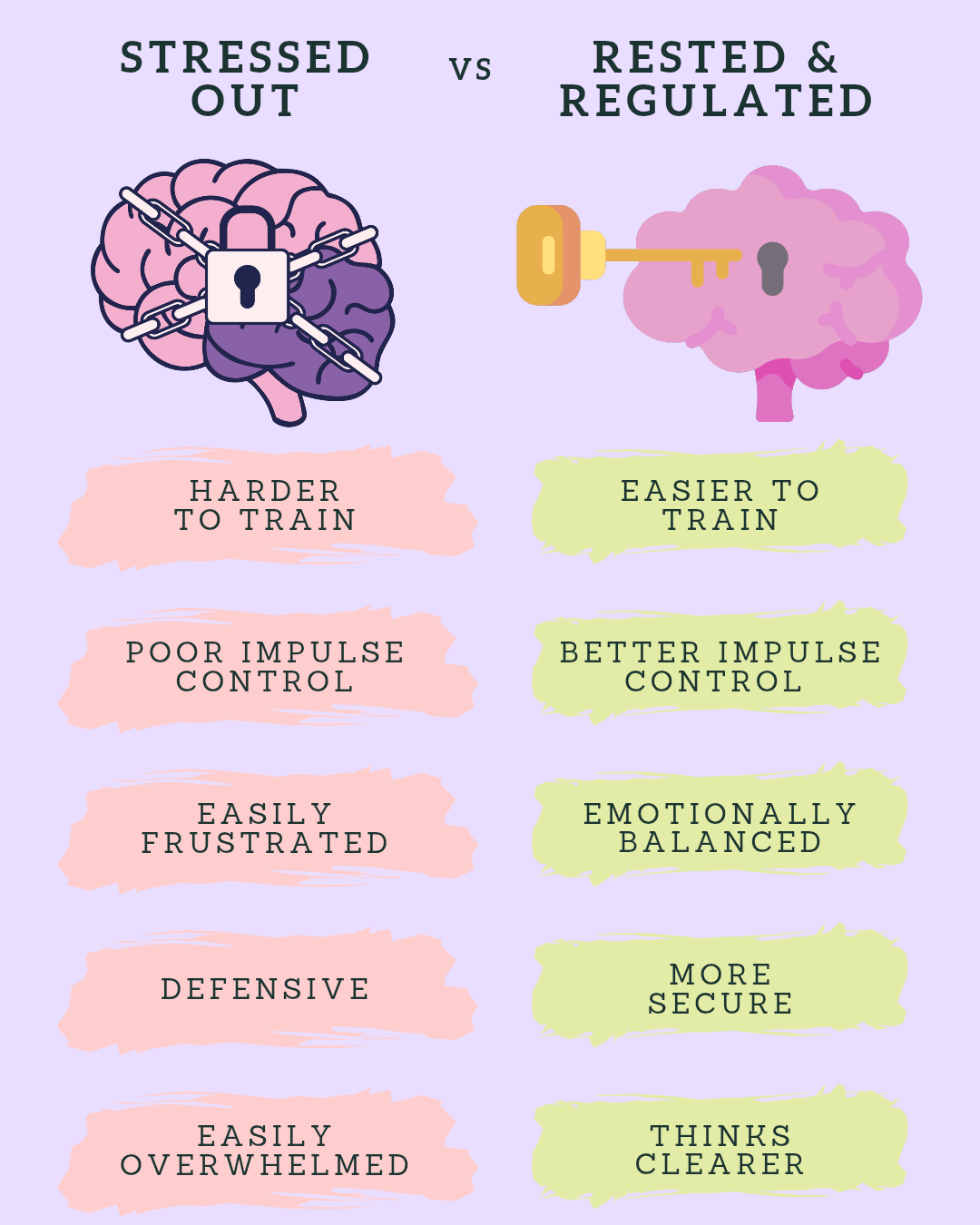
Thankfully, regulation isn't fixed, it's more of a spectrum that dogs can move between. But a lot of dogs can (and often do) get stuck on the dysregulated side more often than not.
This is why it is the first thing I look at, because more often than not, the owners struggling with their dog's behaviour tend to have a dysregulated dog, which make everything harder.
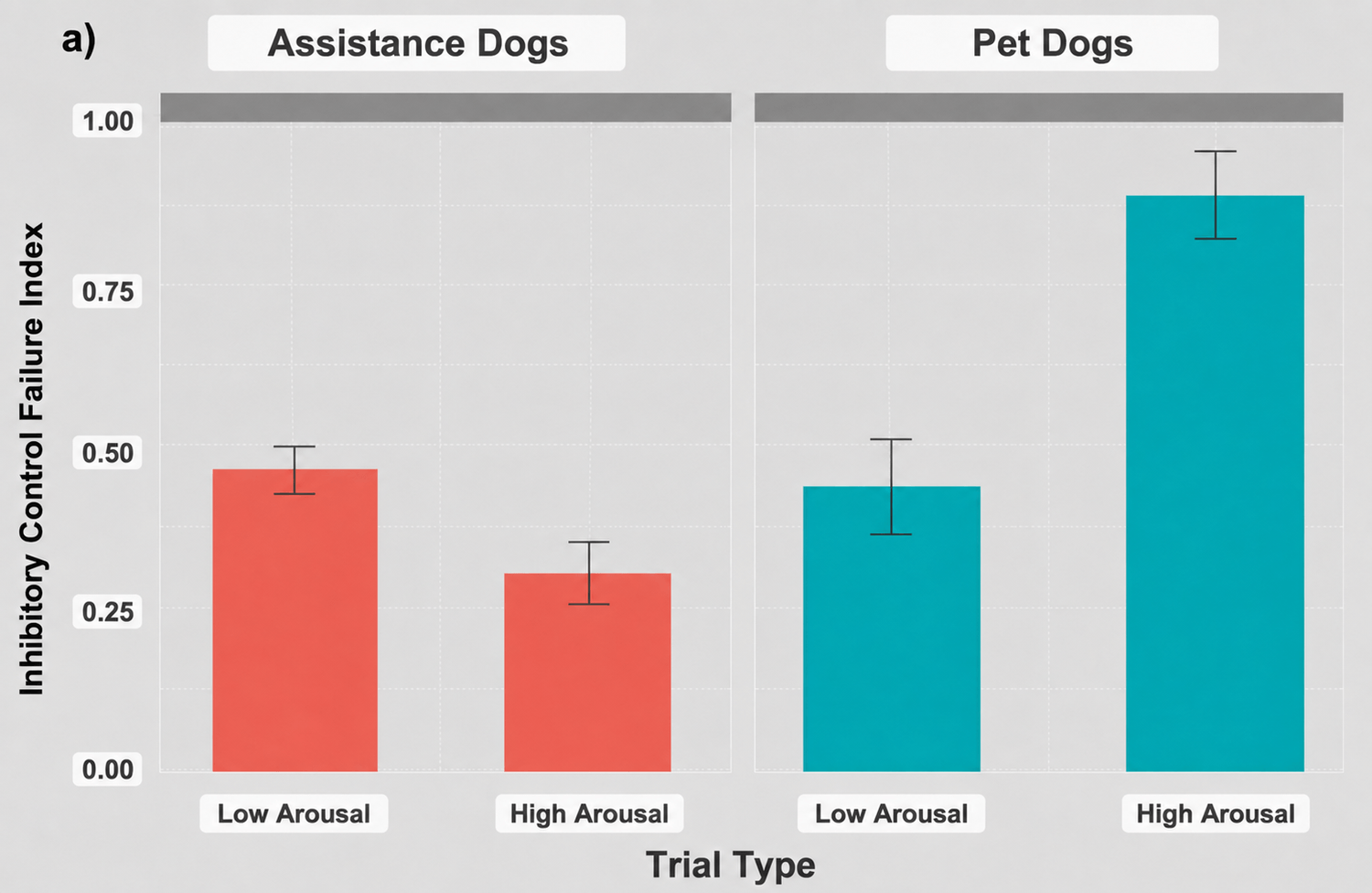
There's a study out of Duke Canine Cognition Centre where researchers tested over a hundred dogs on a self-control task, comparing naturally calm assistance dogs against naturally excitable pet dogs.
Each dog did the same task twice, once in a calmer state of mind, once more excited and stimulated.
The calm and regulated dogs actually did better once the excitement was added.
The already-excitable and more dysregulated pet dogs did worse.
And here's the thing that actually matters for your walks: if your dog is already dysregulated before they've even left the house, and then you add on everything that's waiting outside (the sights, the sounds, the smells, the competing motivators) they go straight over threshold.
No amount of training or motivation work is going to hold up once your dog can't listen outside anyway.
Final Thoughts
Next time your dog won't listen outside, before you write it off as them being stubborn, ask yourself which of these four could be influencing them? Training. Motivation. Leadership/Relationship. Or regulation.
If you want to know exactly how to rebuild regulation in your dog, that's exactly what the first phase of my FREE Regulated and Reliable Dog Roadmap covers.
👉🏾 [Go check it out]
Frequently Asked Questions (FAQs)
Because a behaviour learned in one setting doesn't automatically transfer to another. Your dog might genuinely know "sit" in your kitchen and still not know it next to a busy road, especially if they've only ever practised it somewhere calm and familiar compared to more stimulating environments.
Usually something else. What looks like stubbornness on the outside is more often one of four things: the behaviour was never properly trained for that environment, something else nearby is more motivating than you are, there's no structure or relationship pulling them toward you, or they're too dysregulated to focus, listen, or make good choices in the moment.
Regulation, before anything else. A dog that's already wound up before you've left the house doesn't have the capacity to focus on training or motivation work once you're outside. Getting them regulated first is what makes the other three easier and actually stick.
Not by itself, if regulation, motivation, or the relationship side isn't also in place. A dog can know a cue perfectly well and still not perform it outside if they're overstimulated, more interested in something else, or don't see much reason to check in with you.